Thursday, June 27, 2013

Clarence Thomas: Not Big Enough for the Job

by Ron Powell
 
In joining with the majority in the striking down of Section 4 of the Voting Rights Act, Clarence Thomas has shown, once again, that he simply is not big enough for the job.....
Rather than exercise a modicum of independent thought and expression, Thomas chooses to be the shadow and apparent puppet of his idol Antonin Scalia, with whom he has rarely disagreed, during his tenure on the Court....
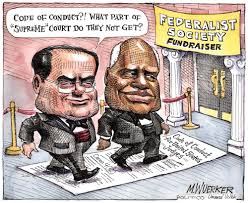
Thomas is markedly unlike an earlier Republican appointee, Chief Justice Earl Warren, who was a model of political reversal after receiving his appointment to the Court:

In 1952, Warren stood as a "favorite son" candidate of California for the Republican nomination for President, hoping to be a power broker in a convention that might be deadlocked. But Warren had to head off a revolt by Senator Richard Nixon, who supported General Dwight D. Eisenhower.
Eisenhower and Nixon were elected, and the bad blood between Warren and Nixon was apparent. Eisenhower offered, and Warren accepted, the post of solicitor general, with the promise of a seat on the Supreme Court. But before it was announced, Chief Justice Fred M. Vinson died suddenly in September 1953 and Eisenhower picked Warren to replace him as Chief Justice of the United States. 
The president wanted what he felt was an experienced jurist who could appeal to liberals in the party as well as law-and-order conservatives, noting privately that Warren "represents the kind of political, economic, and social thinking that I believe we need on the Supreme Court.... He has a national name for integrity, uprightness, and courage that, again, I believe we need on the Court".
                                                                                                                                                               
In the next few years, Warren led the Court in a series of liberal decisions that revolutionized the role of the Court. He is known both for his efforts on behalf of Japanese internment during World War II as well as the decisions of the "Warren Court", which ended school segregation and transformed many areas of American law, especially regarding the rights of the accused, ending public-school-sponsored prayer, and requiring "one-man-one vote" rules of apportionment.
                                                                                                                                                
He made the Court a power center on a more even base with Congress and the presidency especially through four landmark decisions: Brown v. Board of Education (1954), Gideon v. Wainwright (1963), Reynolds v. Sims (1964), and Miranda v. Arizona (1966).
Eisenhower is often said to have remarked that his appointment was "the biggest fool mistake I ever made.".........Wikipedia
                                                                                                                                                           
Clarence Thomas was born in 1948 in Pin Point, Georgia, a small, predominantly black community founded by freedmen after the American Civil War. When he was a child, the town lacked a sewage system and paved roads. He was the second of three children born to M.C. Thomas, a farm worker, and Leola Williams, a domestic worker. They were descendants of American slaves, and the family spoke Gullah as a first language.  Thomas's first-known ancestors were slaves named Sandy and Peggy who were born around the end of the 18th century and owned by wealthy Liberty County, Georgia planter Josiah Wilson.  M.C. Thomas left his family when Thomas was two years old. Thomas's mother worked hard but was sometimes paid only pennies per day. She had difficulty putting food on the table and was forced to rely on charity.  After a house fire left them homeless, Thomas and his younger brother Myers were taken to live with his mother's parents in Savannah, Georgia. Thomas was seven when the family moved in with his maternal grandfather, Myers Anderson, and Anderson's wife, Christine (née Hargrove), in Savannah.
                                                                                                                                                      
Living with his grandparents, Thomas enjoyed amenities such as indoor and regular meals for the first time in his life.  His grandfather Myers Anderson had little formal education, but had built a thriving fuel oil business that also sold ice. Thomas calls his grandfather "the greatest man I have ever known."  When Thomas was 10, Anderson started taking the family to help at a farm every day from sunrise to sunset.  His grandfather believed in hard work and self-reliance; he would counsel Thomas to "never let the sun catch you in bed." Thomas's grandfather also impressed upon his grandsons the importance of getting a good education.
                                                                                                                                                      
Thomas was the only black person at his high school in Savannah, where he was an honor student.
He was the only member of his family to have attended college.....
.....Wikipedia
                                                                                                                                                           
How is it possible for a person with such a background to behave and vote as he has as an associate justice on the highest court in the land?
                                                                                                                                                            
Come on Clarence, couldn't you have, just this once, voted the facts and the truth of your life and upbringing?
                                                                                                                                                                 
You were born and raised in Georgia during the 50's and 60's, for God's sake!!!

Do you hate being black and black people that much?
                                                                                                                                                             
I can't help but think that your grandfather is shouting from his grave:  "the biggest fool mistake I ever made"!!! 

Monday, April 29, 2013

The Senate No Vote: Gun Rack Racism

This is a bushmaster .223


It isn't just a gun, it's an assault rifle....

To put it another way, it's a weapon of mass destruction....

It's the weapon that was used to slaughter children in their school in Newtown, CT.

As many as 90% of the voting population believe that it makes sense to require the purchaser of such a weapon to undergo a background check before taking possession of this or any other "gun" which may be acquired in the open market....

We are being led to believe that the action of the Senate was against the common sense proposals regarding legislation that would require comprehensive background checks....

But it wasn't....

It was another obstructionist vote against the Presidency of Barack Obama....

It was another clear manifestation of the determination that is held by many in Congress, including some Democrats, that Barack Obama should not be permitted to govern, even when it makes sense, and even when it is in the best interest of the country to permit him to do so...

The vote in the Senate was not about whether criminals or crazies should be able to get a bushmaster.....

It was about keeping Obama from being successful in a matter that has overwhelming popular support...

It was about keeping Obama from a political victory that the public wants and needs him to have....

It is in this context, and in this regard, that the negative action taken by the Senate on the matter of universal comprehensive background checks was not just shameful and cowardly, it was a despicable display of what I call 'gun rack' racism....

Public opinion and public safety be damned!


Thursday, March 7, 2013

The End of War and Violence: An Ancient Idea Revisited

My mother would tell folks at family gatherings, or house guests of one sort or another that, when I was in the toddler stages of life, all she need do, while shopping for groceries, was put me in front of the book rack, where I would sit quietly 'playing' with the books I could reach....So it was that by the time I completed the 8th grade I had read: The dictionary, the Bible, Plato, and Homer......


My passion was Greek mythology, sparked by the Homeric Epics, The Iliad and The Odyssey.....When I entered college and discovered that there were entire courses devoted to ancient Greek literature, I felt as though I had died and gone to heaven...


I was introduced to classical Greek plays by authors such as: Aeschylus (c. 525–456 BCE), Sophocles (c. 495-406 BCE), Euripides (c. 480–406 BCE), and one of my favorites, Aristophanes (c. 446-388 BCE), author of Lysistrata.


Illustration from a bust


Lysistrata (translation: "Army-disbander") is one of the few surviving plays written by Aristophanes. Originally performed in classical Athens in 411 BC, it is a comic account of one woman's extraordinary mission to end The Peloponnesian War. Lysistrata persuades the women of Greece to withhold sexual privileges from their husbands and lovers as a means of forcing the men to negotiate peace — a strategy, however, that inflames the battle between the sexes. The play is notable for being an early exposé of sexual relations in a male-dominated society.


Illustration by Aubrey Beardsley, 1896

LYSISTRATA: There are a lot of things about us women that sadden me, considering how men see us as rascals.

CALONICE: As indeed we are!

These lines, spoken by Lysistrata and her friend Calonice at the beginning of the play, set the scene for the action that follows. Women, as represented by Calonice, are sly hedonists in need of firm guidance and direction. Lysistrata however is an extraordinary woman with a large sense of individual responsibility. She has convened a meeting of women from various city states in Greece (there is no mention of how she managed this feat) and, very soon after confiding in her friend about her concerns for the female sex, the women begin arriving.


With support from Lampito, the Spartan, Lysistrata persuades the other women to withhold sexual privileges from their menfolk as a means of forcing them to end the interminable Peloponnesian War. The women are very reluctant but the deal is sealed with a solemn oath around a wine bowl, Lysistrata choosing the words and Calonice repeating them on behalf of the other women. It is a long and detailed oath, in which the women abjure all their sexual pleasures, including The Lioness on The (a sexual position).


Soon after the oath is finished, a cry of triumph is heard from the nearby Acropolis – the old women of Athens have seized control of it at Lysistrata's instigation, since it holds the state treasury, without which the men cannot long continue to fund their war. Lampito goes off to spread the word of revolt and the other women retreat behind the barred gates of the Acropolis to await the men's response. (-Wikipedia)


I'm thinking. what a marvelous idea it would be for women to be able to put an end to war, and street violence, or stop things like corporate greed, congressional gridlock, pollution of the environment and global warming....Just by saying no to sex....


Or, would that be asking too much?

Sunday, February 3, 2013

Black History Month: The Super Bowl

This is the 25th anniversary of the first appearance of a black quarter back in the Super Bowl. With the Redskins trailing the Broncos 10-0 in Super Bowl XXII, Doug Williams, fired four TD strikes in the second quarter alone, including scoring tosses of 80 and 50 yards to Ricky Sanders. He earned MVP honors in the 42-10 victory for a 340-yard effort that set a Super Bowl record at the time.
There were those who understood the impact of the Williams appearance and victory, just as the effect the appearance of Jackie Robinson in a Brooklyn Dodger uniform was understood some 40 years earlier.
I could go on here, but if a picture is worth a thousand words: 'nuff said'....

Wednesday, December 19, 2012

Guest Post: Time Magazine's "Person of the Year", 2012

President Obama is 'Time' Person of the Year Originally posted by Hillary Busis at Entertainment Weekly.com, December 19, 2012
President Barack Obama has been named Time Magazine’s “Person of the Year” for a second time, following his initial selection in 2008. The only other person to have been selected for this honor twice was Charles Lindberg. In a blog post, Time managing editor Richard Stengel explains that Obama was chosen because he is a cultural figure as well as a political one: “There has been much talk of the coalition of the ascendant — young people, minorities, Hispanics, college-educated women — and in winning re-election, Obama showed that these fast-growing groups are not only the future but also the present,” he writes. “If his win in 2008 was extraordinary, then 2012 is confirmation that demographic change is here to stay.” The president beat out 15-year-old Pakistani activist Malala Youfsafzai, Apple CEO Tim Cook, Egyptian president Mohamed Morsi, and Italian CERN physicist Fabiola Gianotti for the annual honor.

Monday, December 17, 2012

"We can't tolerate this any more...." Video and Full Text: President Obama's Speech in Newtown, Connecticut

Full text of speech: To all the families, first responders, to the community of Newtown, clergy, guests, scripture tells us, “Do not lose heart. Though outwardly we are wasting away, inwardly, we are being renewed day by day. For light and momentary troubles are achieving for us an eternal glory that far outweighs them all, so we fix our eyes not on what is seen, but on what is unseen, since what is seen is temporary, but what is unseen is eternal. For we know that if the earthly tent we live in is destroyed, we have a building from God, an eternal house in heaven not built by human hands. We gather here in memory of 20 beautiful children and six remarkable adults. They lost their lives in a school that could have been any school in a quiet town full of good and decent people that could be any town in America. Here in Newtown, I come to offer the love and prayers of a nation. I am very mindful that mere words cannot match the depths of your sorrow, nor can they heal your wounded hearts. I can only hope it helps for you to know that you’re not alone in your grief, that our world, too, has been torn apart, that all across this land of ours, we have wept with you. We’ve pulled our children tight. And you must know that whatever measure of comfort we can provide, we will provide. Whatever portion of sadness that we can share with you to ease this heavy load, we will gladly bear it. Newtown, you are not alone. As these difficult days have unfolded, you’ve also inspired us with stories of strength and resolve and sacrifice. We know that when danger arrived in the halls of Sandy Hook Elementary, the school’s staff did not flinch. They did not hesitate. Dawn Hochsprung and Mary Sherlach, Vicki Soto, Lauren Rousseau, Rachel Davino and Anne Marie Murphy — they responded as we all hope we might respond in such terrifying circumstances, with courage and with love, giving their lives to protect the children in their care. We know that there were other teachers who barricaded themselves inside classrooms and kept steady through it all and reassured their students by saying, “Wait for the good guys, they are coming. Show me your smile.” And we know that good guys came, the first responders who raced to the scene helping to guide those in harm’s way to safety and comfort those in need, holding at bay their own shock and their own trauma, because they had a job to do and others needed them more. And then there were the scenes of the schoolchildren helping one another, holding each other, dutifully following instructions in the way that young children sometimes do, one child even trying to encourage a grown-up by saying, “I know karate, so it’s OK; I’ll lead the way out.” As a community, you’ve inspired us, Newtown. In the face of indescribable violence, in the face of unconscionable evil, you’ve looked out for each other. You’ve cared for one another. And you’ve loved one another. This is how Newtown will be remembered, and with time and God’s grace, that love will see you through. But we as a nation, we are left with some hard questions. You know, someone once described the joy and anxiety of parenthood as the equivalent of having your heart outside of your body all the time, walking around. With their very first cry, this most precious, vital part of ourselves, our child, is suddenly exposed to the world, to possible mishap or malice, and every parent knows there’s nothing we will not do to shield our children from harm. And yet we also know that with that child’s very first step and each step after that, they are separating from us, that we won’t — that we can’t always be there for them. They will suffer sickness and setbacks and broken hearts and disappointments, and we learn that our most important job is to give them what they need to become self-reliant and capable and resilient, ready to face the world without fear. And we know we can’t do this by ourselves. It comes as a shock at a certain point where you realize no matter how much you love these kids, you can’t do it by yourself, that this job of keeping our children safe and teaching them well is something we can only do together, with the help of friends and neighbors, the help of a community and the help of a nation. And in that way we come to realize that we bear responsibility for every child, because we’re counting on everybody else to help look after ours, that we’re all parents, that they are all our children. This is our first task, caring for our children. It’s our first job. If we don’t get that right, we don’t get anything right. That’s how, as a society, we will be judged. And by that measure, can we truly say, as a nation, that we’re meeting our obligations? Can we honestly say that we’re doing enough to keep our children, all of them, safe from harm? Can we claim, as a nation, that we’re all together there, letting them know they are loved and teaching them to love in return? Can we say that we’re truly doing enough to give all the children of this country the chance they deserve to live out their lives in happiness and with purpose? I’ve been reflecting on this the last few days, and if we’re honest with ourselves, the answer’s no. We’re not doing enough. And we will have to change. Since I’ve been president, this is the fourth time we have come together to comfort a grieving community torn apart by mass shootings, fourth time we’ve hugged survivors, the fourth time we’ve consoled the families of victims. And in between, there have been an endless series of deadly shootings across the country, almost daily reports of victims, many of them children, in small towns and in big cities all across America, victims whose — much of the time their only fault was being at the wrong place at the wrong time. We can’t tolerate this anymore. These tragedies must end. And to end them, we must change. We will be told that the causes of such violence are complex, and that is true. No single law, no set of laws can eliminate evil from the world or prevent every senseless act of violence in our society, but that can’t be an excuse for inaction. Surely we can do better than this. If there’s even one step we can take to save another child or another parent or another town from the grief that’s visited Tucson and Aurora and Oak Creek and Newtown and communities from Columbine to Blacksburg before that, then surely we have an obligation to try. In the coming weeks, I’ll use whatever power this office holds to engage my fellow citizens, from law enforcement, to mental health professionals, to parents and educators, in an effort aimed at preventing more tragedies like this, because what choice do we have? We can’t accept events like this as routine. Are we really prepared to say that we’re powerless in the face of such carnage, that the politics are too hard? Are we prepared to say that such violence visited on our children year after year after year is somehow the price of our freedom? You know, all the world’s religions, so many of them represented here today, start with a simple question. Why are we here? What gives our life meaning? What gives our acts purpose? We know our time on this Earth is fleeting. We know that we will each have our share of pleasure and pain, that even after we chase after some earthly goal, whether it’s wealth or power or fame or just simple comfort, we will, in some fashion, fall short of what we had hoped. We know that, no matter how good our intentions, we’ll all stumble sometimes in some way. We’ll make mistakes, we’ll experience hardships and even when we’re trying to do the right thing, we know that much of our time will be spent groping through the darkness, so often unable to discern God’s heavenly plans. There’s only one thing we can be sure of, and that is the love that we have for our children, for our families, for each other. The warmth of a small child’s embrace, that is true. The memories we have of them, the joy that they bring, the wonder we see through their eyes, that fierce and boundless love we feel for them, a love that takes us out of ourselves and binds us to something larger, we know that’s what matters. We know we’re always doing right when we’re taking care of them, when we’re teaching them well, when we’re showing acts of kindness. We don’t go wrong when we do that. That’s what we can be sure of, and that’s what you, the people of Newtown, have reminded us. That’s how you’ve inspired us. You remind us what matters. And that’s what should drive us forward in everything we do for as long as God sees fit to keep us on this Earth. “Let the little children come to me,” Jesus said, “and do not hinder them, for to such belongs the kingdom of heaven.” Charlotte, Daniel, Olivia, Josephine, Ana, Dylan, Madeleine, Catherine, Chase, Jesse, James, Grace, Emilie, Jack, Noah, Caroline, Jessica, Benjamin, Avielle, Allison, God has called them all home. For those of us who remain, let us find the strength to carry on and make our country worthy of their memory. May God bless and keep those we’ve lost in his heavenly place. May he grace those we still have with his holy comfort, and may he bless and watch over this community and the United States of America.